How to Make Your Curls Last Longer, Whatever Your Hair Type

If your curls always drop, the chances are it’s not your hair that’s the problem.
A curl has to be built, cooled and sealed in that order.
Here’s how to make your curls last longer, whatever your hair type.
Tools and materials:
- Lightweight volumizing conditioner
- Soft mousse
- Curling irons
- Pin curls (optional)
- Wide-toothed comb
- Anti-humidity finishing spray
Upstyle Recommends!

1. Why curls drop
Different hair types fall for very different reasons.

Your hair already has a natural shape, which you can see when you allow it to air dry. This is its default setting and the one it will return to.
The only two ways to change that default setting are by using water or heat.
Water changes the hair structure temporarily by breaking down hydrogen bonds, allowing for wet styling such as during a blow out or blow dry.
Heat allows the hair to be reshaped by breaking down the same bonds during dry styling, for example by using curling irons.
Both of these changes are temporary and over time your hair will always want to return to its default shape.

Fine hair struggles to hold a curl because it’s too soft or too slippery, especially if it’s over-conditioned or coated in heavy products.

Heat doesn’t always completely penetrate coarse hair, so curls tend to drop quickly because the inside core of the hair was never fully heated.

Chemically treated or bleached hair is more porous, so it reacts to moisture much faster. Curls tend to form easily but fall or frizz the moment you step into any kind of humid atmosphere.
If your curls drop quickly, the problem is usually not enough heat, oversized sections or not enough cooldown.
If your curls are great indoors but collapse outside, humidity is most likely the issue.
If your hair feels silky and smooth but refuses to hold a curl, it has too much slip.
Once you understand why your curls are failing, fixing them becomes pretty simple.

2. Preparation
On the days when you want your hair to be curly, switch to a lighted, volumizing conditioner.
This is especially important for fine hair. Avoid formulas labeled “repair” or “hydrating” because these will likely be too heavy to enable your hair to hold a curl.
If your hair gets oily quickly, product residue may be building up. Try using a clarifying shampoo once a week.
On every other day, make sure that you’re shampooing your hair twice. The second shampoo is important to help prevent product build-up.

Add structure with a lightweight mousse or foam.
Apply it to damp hair and allow it to fully dry before styling.

3. Creating the curl
The size of each section is the most critical part of the curling process.
If sections are too large, hair doesn’t heat evenly.
It may look as if it’s curled but because the internal shape is never properly set, the curl will slowly relax as it cools.

A general rule is that section size should roughly match the size of your curling iron.
If your hair is fine, using a small iron and curl it in small sections.
Larger irons are great for barrel curls on long hair, but they’re also the most likely to fall quickly.

4. Cooling
Until the hair has cooled completely, the shape is still flexible.
Ideally, you want to catch the curl and support it in your hand for a few seconds while it cools down.

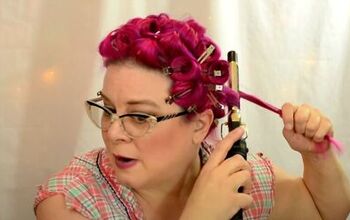
You can also pin each curl in place as you create it. This does take quite a lot of extra time, so I save it for special occasions.

Once the curls have been created, don’t touch your hair at all until they have cooled completely, which will take around ten minutes.

5. Finishing products
Once your curls are completely cool, comb through them gently with a wide-toothed comb.

When it’s time to use your finishing spray, less is more.
You’re not trying to freeze the hair in place, but creating a light, protective layer that helps the curls resist gravity and moisture.
Mist lightly with the spray and work in layers.
If you live in a humid climate, make sure your spray has anti-humidity properties or add a separate, dedicated spray for that, used in the same way.
Fine hair works best with a very lightweight hold or a texture spray.
Thicker or more humidity-prone hair needs a heavier hairspray, but you still need to apply it lightly, in layers.

How to make your curls last longer
Follow these basic principles to make your curls last longer, and they won’t drop out an hour after you arrive at your event.
Whether your hair is fine, coarse or chemically treated, you can have beautiful, long-lasting curls if you work with your hair type.
Please drop me a comment below and let me know if this was helpful.
The author may collect a small share of sales from the links on this page.
















Comments
Join the conversation